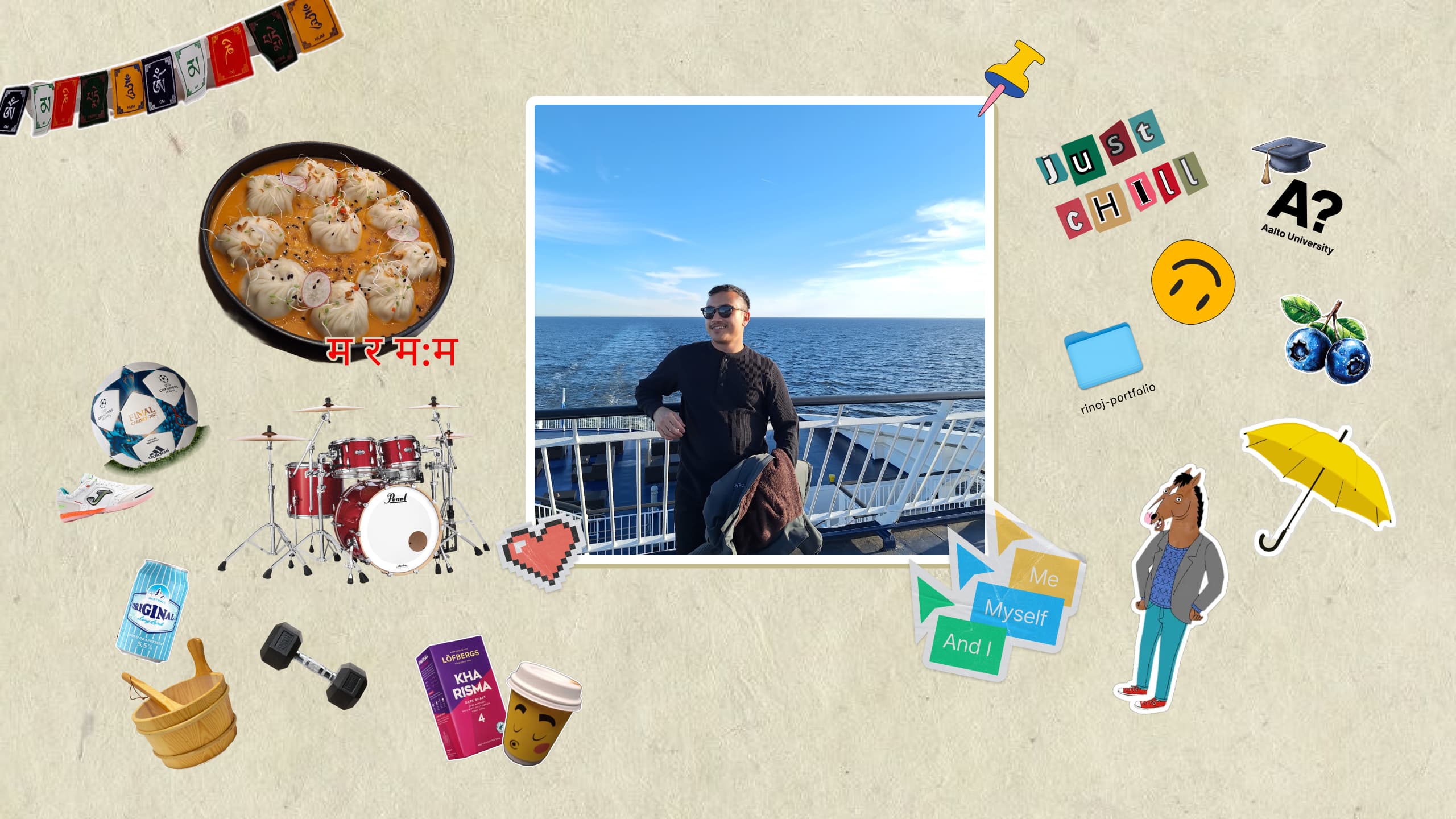
Hi, I am Rinoj
/riːˈnoʊdʒ/ or /riː.noi/ 🇫🇮 — but I pronounce it as: /riːˈnoʊz/ (Ree-nose 👃)
I'm most useful in the gap between business strategy, developer realities, and what people need. My work fits under Product Design and User Interface Design, and I enjoy sprinkling creativity (clever micro-animations, piece of punny copy) into functional spaces (whenever necessary).
What do I bring?
I understand the problem and its surroundings
At Wärtsilä, that meant talking with engineers who still record engine measurements on paper, by hand, to see what a digital tool would actually need to replace.
I help decide
At Bhoos, that meant being in the room when strategy decisions got made, not just handed them afterward.
I design
At Bhoos, that ranged from a game dashboard to websites to apparel to lyrics for a campaign jingle, whatever the problem needed.
I ship and learn
This portfolio site is itself an example, built with Claude Code, then watched through Vercel Analytics and Speed Insights to see what actually holds up.
What's my story?
2019 - 2020
The spark and the obsession
It all started in 2019, when Human-Computer Interaction showed up as an elective in my Computer Science and Engineering degree. Until then, I'd only known the computer side of computers — HCI showed me the human side. When the world shifted with COVID-19, I found myself shifting too, into books, online courses, and a newfound interest in design.
I read this book "The Design of Everyday Things" by Don Norman. After reading it, I couldn't look at anything the same way, starting with my own TV remote, which somehow has more buttons than my TV has channels. I followed it with more Coursera courses than I'm willing to count (thanks, Coursera), and each one sharpened what I actually meant when I said I cared about "good design."
2020 - 2023
The opportunity
My first UX opportunity was at Bhoos, as a UX Design Trainee. One month I was designing a website. The next, a game data dashboard. Then mobile apps, football jerseys, posters, even writing lyrics for a jingle for a social media campaign. I was just enjoying being trusted with whatever needed figuring out.
It's the kind of work I still look for: give me a real problem, even one I don't know yet, and I'll figure it out and own it end to end.
2023 - 2025
The bigger picture
I understood how to design and build things, but not always what makes sense to build (the business side). So I moved to Finland for a master's in International Design Business Management (IDBM) at Aalto University.
Lots of different learnings, but the main thing I take away is to love the problem, look at it from multiple angles and multiple perspectives, and ask questions.
In between, IDBM's Industry Project placed me at Wärtsilä. I was involved in designing a dashboard concept for users juggling 25 parallel tasks. I learned how engineers still record marine engine measurements on paper, by hand, in loud engine rooms and what it costs when one number lands in the wrong column.
Before Wärtsilä, I assumed the data was already there and design's job was just showing it well. Wärtsilä taught me that the data isn't always there, that the stakes are physical, and that adding a digital tool to a manual process could save a lot of time but could also make the actual task a bit unnatural.
Now
The next chapter
Bhoos taught me to move across problems — a website, then a game dashboard, then a marketing poster. Wärtsilä taught me that the data isn't always there, and the stakes can be physical. IDBM taught me to ask better questions before reaching for a solution.
Now, I'm looking for an early-stage or scale-up team next, ideally one that connects digital and physical experiences, or works on systems that are hard to make usable and humane. A team where research and making happen close together, and where design has enough room to push back.
Outside design
I'm a life-long football fan/interesting stuff reader/thrice-a-week gym goer/occasional drummer/random explorer/part-time landscape photographer/sauna lover/food enthusiast/volunteer/____